What is induction?
Induction is a method used to prove that a mathematical statement is true for a set of natural numbers.
In this article, I will use induction to prove that a philosophical statement is true for a set of decisions a human can make in their lifetime. Thereby proving that you have no free will.
The premise
In order to accept this proof, we must first agree on a premise.
The premise is: In any decision that a human makes, there are only 2 ingredients involved in making that decision:
- Your genetics and biological makeup.
- Your lived experience up until the point of making that decision.
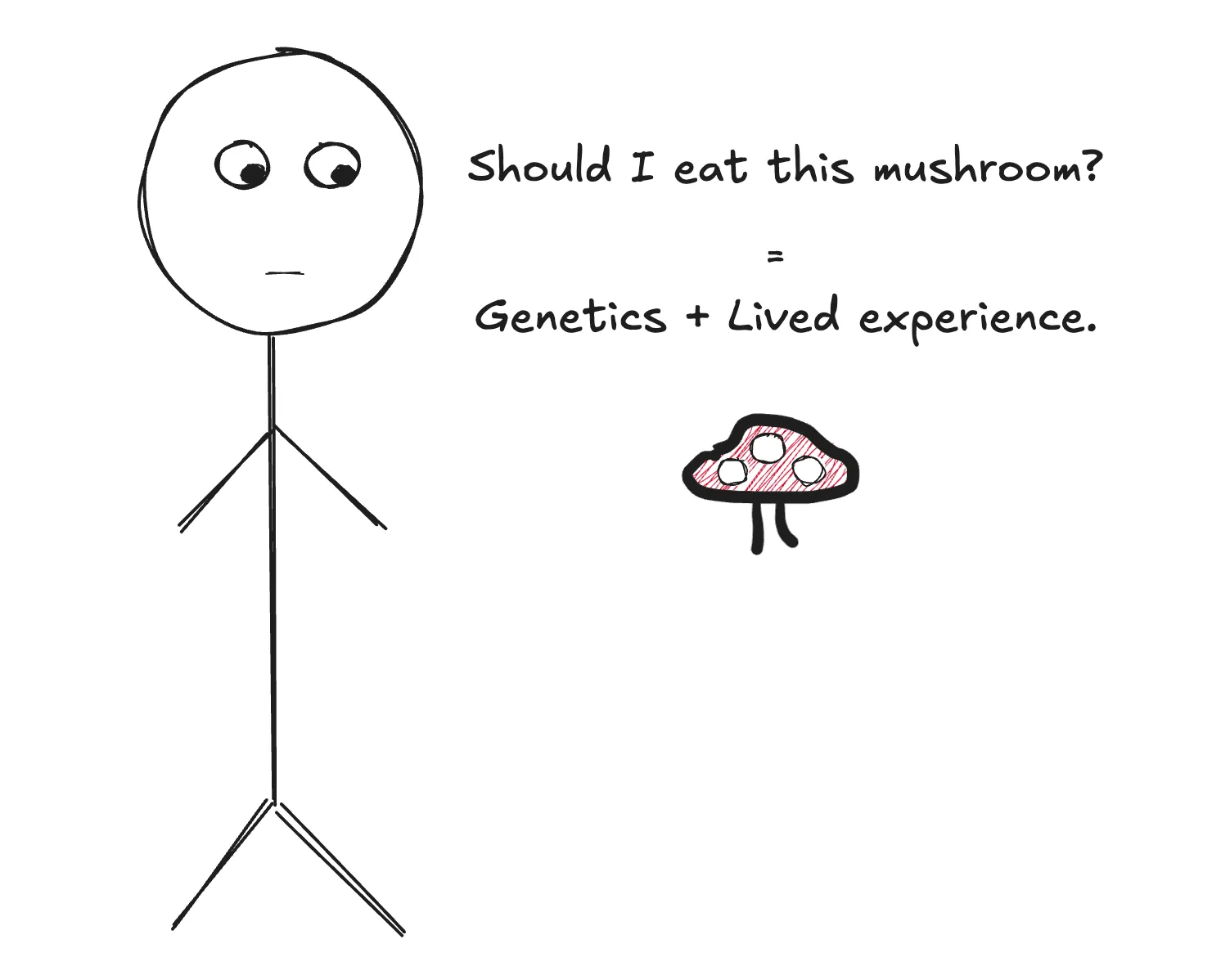
Why?
A human is basically just a cesspit of atoms performing complex chemical operations that manifest to us as consciousness, free will and living life. So the only variable that determines what decisions we make is our atomic composition.
Your genetics and biological makeup inform the initial state of your atoms and your lived experience affects how these change over time. So if you think about it, those are really the only 2 things that can influence a decision you make.
That’s a bit reductive…
Boiling down human existence to a flurry of chemical operations is a bit reductive.
A lot of people believe there is something else immaterial to human existence. The most common example is a soul. If you believe in something like this, fair enough. It’s an unfalsifiable claim.
Believing in a soul probably gives you room to disagree with this premise and carry on with your life. Or you can let me humour you and continue reading.
For those who are comfortable with a physicalist world view, this premise can be accepted and we can dive into the proof.
The proof
Here I will follow the anatomy of a proof by induction, using words and some mathematical symbols.
Note that this is not induction in the strict mathematical sense, but a structural analogy. The title is a bit click-baity (not that anyone will read this).
Inductive statement
Let 𝑃(𝑛) be the statement: “Every decision you make does not contain free will for all moments of your life.”
In mathematical terms: 𝐺 + 𝐸ₙ contains no 𝐹, ∀𝑛∈{0, 1, 2, … , 𝐿}, where:
| Symbol | Definition |
|---|---|
| 𝐺 | Genetic makeup. |
| 𝐸ₙ | Lived experience up to 𝑛 point in your life. |
| 𝐹 | Free will. |
| 𝐿 | The age you will die. This can be in any unit, seconds, years, minutes etc. |
Here, + denotes causal composition rather than numerical addition.
Notice that 𝐺 is static for every decision because your genetics are decided when you are born and does not change. 𝐸 is a function of 𝑛 because your lived experience changes over time.
Base case
Prove true for 𝑛 = 0. Also known as the moment you are born.
𝑃(𝑛₀) = 𝐺 + 𝐸₀
Well 𝐺 contains no free will because you don’t control your genetics. 𝐸₀ also contains no free will because at this point you have no lived experience. Therefore we can say this statement is true in the base case.
Conceptually, the first ever decision you make contains no free will because you didn’t decide on your genetics and you have no lived experience.
Induction hypothesis
Assume 𝑃(𝑘) is true for some arbitrary integer 𝑘.
𝑃(𝑛ₖ) = 𝐺 + 𝐸ₖ
Assume that there is no free will in a decision you made at a random year in your life 𝑘.
Inductive step
I am going to show that if the hypothesis holds for 𝑘, then it must also hold for 𝑘 + 1.
𝑃(𝑘 + 1) is true for all 𝑘 ⩾ 𝑛₀
In other words, every decision you make contains no free will for all moments in your life.
Let’s imagine 𝑛 = 1.
𝑃(𝑛₁) = 𝐺 + 𝐸₁
Your lived experience is influenced by previous decisions you have made. So that’s evidence for free will, right?
But at 𝑛 = 1 the only prior decisions you have made contained no free will and therefore your lived experience at 𝑛 = 1 was completely outside of your control. So this next decision you make is also completely out of your control.
Mathematically
𝑃(𝑛₁) = 𝐺 + (𝐸₀ + 𝐸₁)
We can ignore 𝐺 because we know there is no free will in determining your genetic makeup.
𝑃(𝑛₁) = 𝐸₀ + 𝐸₁
Which can be re-written as:
𝑃(𝑛₁) = 𝑃(𝑛₀) + 𝐸₁
We know there is no free will in 𝑃(𝑛₀) from the base case, and we have just reasoned that 𝐸₁ also contains no free will. Therefore the statement is also true for 𝑃(𝑛₁).
More generally
𝑃(𝑛ₖ) = 𝐸₀ + 𝐸₁ + … + 𝐸ₖ
𝑃(𝑛𝑘 + 1) = 𝐸₀ + 𝐸₁ + … + 𝐸ₖ + (𝐸𝑘 + 1)
Which can be re-written as:
𝑃(𝑛𝑘 + 1) = 𝑃(𝑛ₖ) + (𝐸𝑘 + 1)
𝐸𝑘 + 1 itself is the result of external stimuli and prior internal state, neither of which are freely chosen. So we know 𝑃(𝑛𝑘 + 1) is true. QED.
Or conceptually, because the first decision you ever make is completely outside of your control, so is the next decision you make and the next and the next until you die. Therefore every decision you make does not contain free will.
What does this mean?
I have just mathematically and systematically proven without a shred of doubt that you have no free will (hopefully my facetiousness reads through). So what does this mean?
Is everyone just on a pre-determined path that they have no control over? Does this determinism extend to the entire universe? If we can’t change the outcome of the future, what is the point of even trying to change anything?
I touched on similar ideas in “A deterministic universe and what to do about it” and 4 years later I still reach the same conclusion.
Yes you probably don’t have any free will and you’re essentially just a passenger in a pre-determined universe. But does that really matter? You can still make decisions that improve your life and the lives of others, even if those decisions were already pre-determined.
We are still capable of love, joy, connection, pain, jealousy, anguish, happiness. These are experiences unique to being human and having no free will does not change that. So find gratitude in your existence and try to be patient with your fellow humans who are also mere passengers on their empty boat.